Snapshot
- Core concept: Dental implants osseointegrate with alveolar bone to support crowns or bridges.
- Primary role: Replace missing teeth with a fixed, load-bearing prosthesis independent of adjacent dentition.
- Key components: Implant fixture, abutment interface, definitive prosthesis.
- Clinical advantages: High bite force tolerance, bone preservation, superior biomechanics, and long-term predictability.
- Success determinants: Bone quality, CBCT-based planning, implant positioning, prosthetic design, occlusal management, and maintenance compliance.
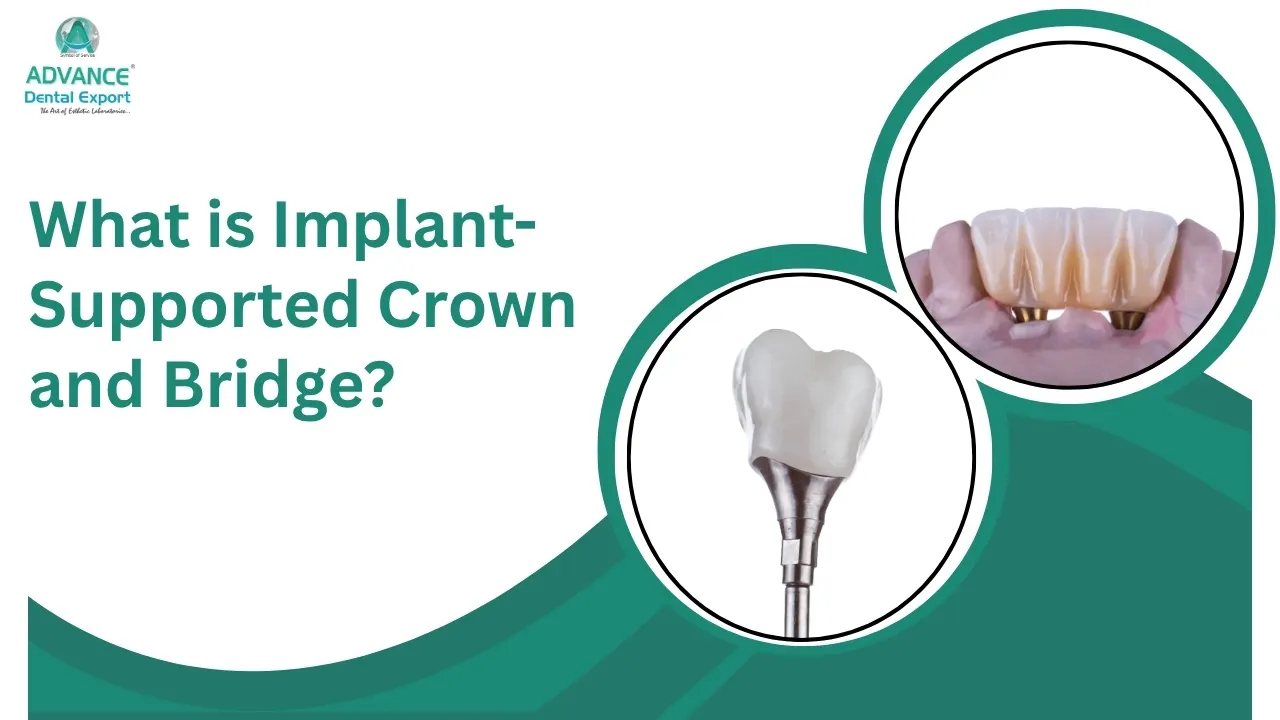
What is an Implant-Supported Crown and Bridge?
An implant-supported crown and bridge is a fixed dental prosthesis retained by one or more endosseous implants rather than natural teeth.
Clinical Indications
- Single missing tooth: Implant-supported crown
- Multiple adjacent missing teeth: Implant-supported bridge
- Compromised abutment teeth: Avoids preparation of adjacent dentition
- Post-extraction bone preservation: Maintains ridge volume
These restorations are fully independent, biomechanically stable, and functionally comparable to natural dentition when properly planned and executed.
Dental implant crowns and bridges offer superior stability, durability, and comfort compared to traditional dentures or standalone bridges. These restorations look and function like natural teeth and do not rely on neighbouring natural teeth for support.
Why Implant-Supported Crown and Bridge the Gold Standard Today?
The implant-supported crown and bridge has become the preferred fixed prosthetic solution for single and multiple tooth replacement due to its superior biomechanical performance and long-term clinical outcomes. Unlike tooth-supported restorations, implant prostheses transfer occlusal forces directly to bone, preserving adjacent teeth and maintaining alveolar architecture.
For clinicians, implant-supported restorations offer predictable functional rehabilitation, enhanced aesthetics, and scalable treatment options—from single crowns to full-arch bridges—supported by evidence-based protocols.
Full-Arch Implant-Supported Bridge (All-on-4 / All-on-6 Concepts)
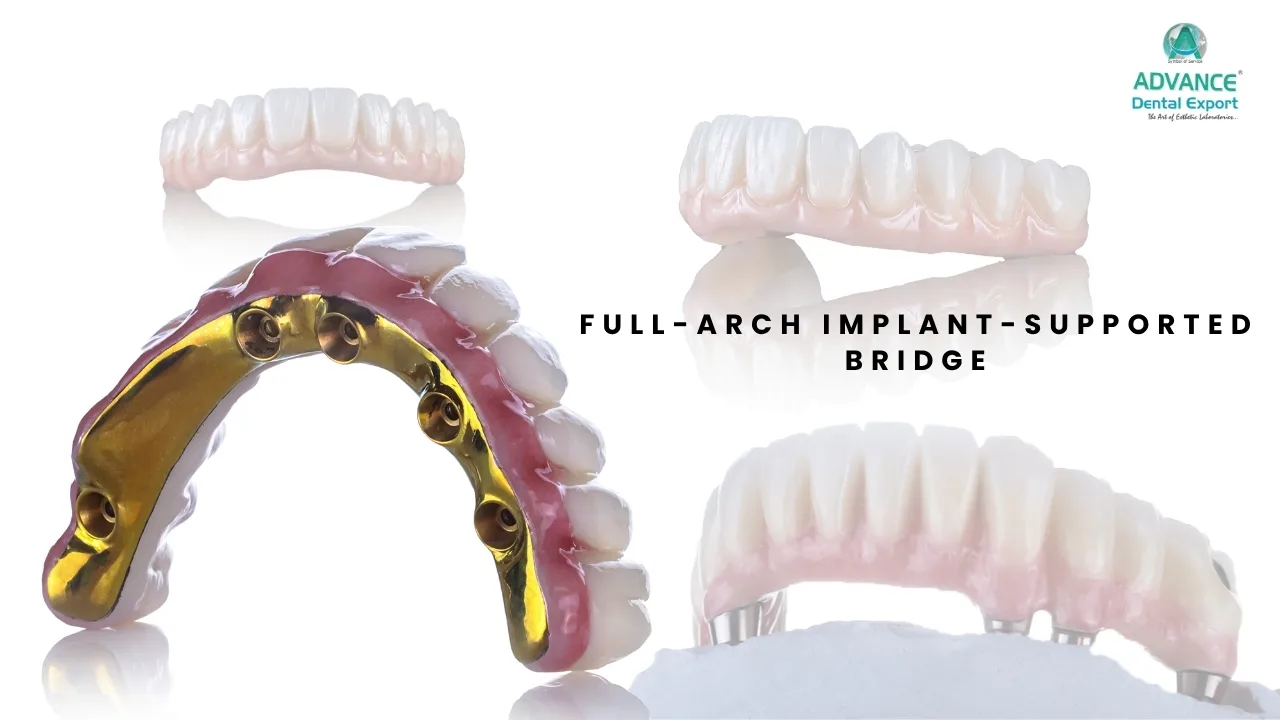
A full-arch implant bridge is a long-span prosthesis designed to replace an entire upper or lower arch of missing teeth. Instead of placing an implant for every tooth, four to six strategically positioned implants support a single, continuous bridge that spans the full arch.
This approach provides exceptional stability and eliminates the movement and discomfort associated with removable dentures. It is a durable, permanent solution ideal for patients seeking a natural-looking, long-term replacement for complete tooth loss.


Clinical Advantages
- Eliminates removable denture instability
- Allows immediate or early loading in selected cases
- Restores vertical dimension and facial support
- Suitable for severe partial or complete edentulism
This protocol has become a mainstream solution in advanced implant practices due to reduced treatment time and high patient acceptance.
Types of Implant Prostheses Used in Clinical Practice
Depending on edentulism pattern and biomechanical requirements, implant prosthetic options include:
- Single Implant Crown – Individual tooth replacement
- Implant-Supported Bridge – Multi-unit fixed prosthesis
- Full-Arch Implant Restoration – Fixed complete arch rehabilitation
- Implant-Retained Overdentures – Removable prosthesis with implant anchorage
- Fixed Hybrid Prosthesis – Acrylic or composite over a metal framework
Each prosthesis requires case-specific planning to balance load distribution, hygiene access, and long-term maintenance.
Clinical Benefits of Implant-Supported Crowns and Bridges
From a clinician’s perspective, implant prostheses provide measurable advantages:
Biomechanical Stability
Osseointegrated implants offer superior load distribution, enabling high bite forces without stressing adjacent teeth.
Alveolar Bone Preservation
Functional stimulation prevents progressive bone resorption common in tooth-supported bridges and removable dentures.
Prosthetic Predictability
High survival rates (95–98%) with controlled variables such as implant position, occlusion, and material selection.
Aesthetic Control
Emergence profile, gingival contours, and shade matching can be precisely managed using digital workflows.
Long-Term Cost Efficiency
Although initially higher, implant restorations reduce re-treatment and biological complications over time.
Longevity of Implant-Supported Dental Prostheses
- Implant fixture: 20+ years or lifetime with proper maintenance
- Crowns & bridges: Typically 10–15 years, depending on material and occlusal forces
Longevity is influenced by prosthetic design, occlusion, parafunctional habits, oral hygiene, and recall compliance.
Clinical Workflow of Dental Implant Prostheses
The implant procedure is carried out in stages for optimal healing and stability:
1. Diagnostic Evaluation & CBCT Planning
- Clinical examination and prosthetic-driven planning
- CBCT assessment of bone height, width, density, and anatomical structures
- Digital planning enables accurate implant positioning and angulation
2. Surgical Implant Placement
- Performed under local anesthesia
- Guided or freehand placement, depending on case complexity
- Primary stability is critical for loading decisions
3. Osseointegration Phase
- Healing period: 3–6 months (may vary with bone quality)
- Bone-implant interface matures to support functional loading
4. Abutment Connection
- Soft tissue management and emergence profile shaping
- Selection of stock vs custom abutments based on prosthetic needs
5. Definitive Prosthesis Delivery
- CAD/CAM or conventional fabrication
- Occlusal adjustment and functional verification
- Final cementation or screw-retention
Implant-Supported Crown vs Bridge: Clinical Comparison
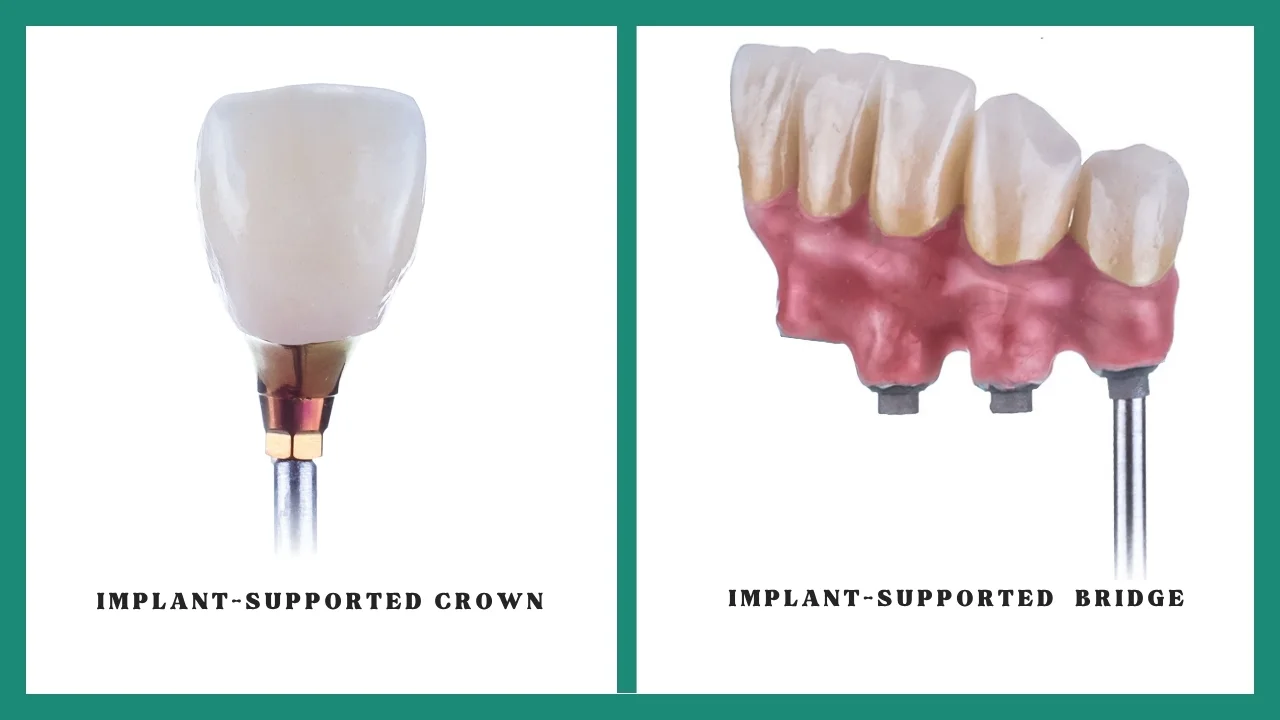
The choice depends on the number of missing teeth. A crown is ideal when only a single tooth needs replacement, while a bridge is preferred when multiple adjacent teeth are missing and can be restored using fewer implants to support the prosthesis.
Looking for a trusted lab partner? Get high-precision restorations from Advance Dental Export
Both options are effective but serve different purposes:
|
Parameter |
Implant-Supported Crown |
Implant-Supported Bridge |
|
Indication |
Single tooth loss |
Multiple adjacent teeth |
|
Implants required |
One |
Two or more |
|
Prosthetic span |
Single unit |
Multi-unit |
|
Occlusal load |
Localized |
Distributed |
|
Maintenance |
Simple |
Requires hygiene planning |
Both implant-supported crowns and bridges offer excellent stability, aesthetics, and long-term benefits when supported by implants.
Maintenance Protocol for Implant-Supported Prostheses
Good oral hygiene protects both the implants and the surrounding tissues .
- Professional recalls every 3–6 months
- Peri-implant tissue monitoring
- Occlusal evaluation to prevent overload
- Patient education on interproximal hygiene aids
- Early detection of peri-implant disease
Take Home Message
The implant-supported crown and bridge represent the most predictable, biologically sound, and functionally superior prosthetic solution available today. With advancements in CBCT diagnostics, digital planning, and material science, clinicians can deliver long-term outcomes with exceptional patient satisfaction.
👉 Looking to Enhance Your Implant Prosthetic Outcomes?
Partner with the Advance Dental Export that understands implant biomechanics, occlusal precision, and prosthetic longevity.
Precision-engineered crowns and bridges start with the right lab collaboration.
FAQs
What is the success rate of implant-supported crown and bridge?
Clinical studies report 95–98% long-term success when proper surgical and prosthetic protocols are followed.
How many implants are required for an implant-supported bridge?
Typically, two implants can support a three-unit bridge, depending on span length and occlusal load.
Which materials are best for implant-supported crowns and bridges?
Zirconia is preferred for high-strength, aesthetic zones, while PFM remains viable for posterior regions.
Can implant-supported crowns be immediately loaded?
Yes, immediate loading is possible in cases with high primary stability and controlled occlusion.
How does an implant-supported bridge differ from a traditional bridge biologically?
Implants preserve bone and avoid preparation of adjacent teeth, unlike conventional bridges.