Snapshot
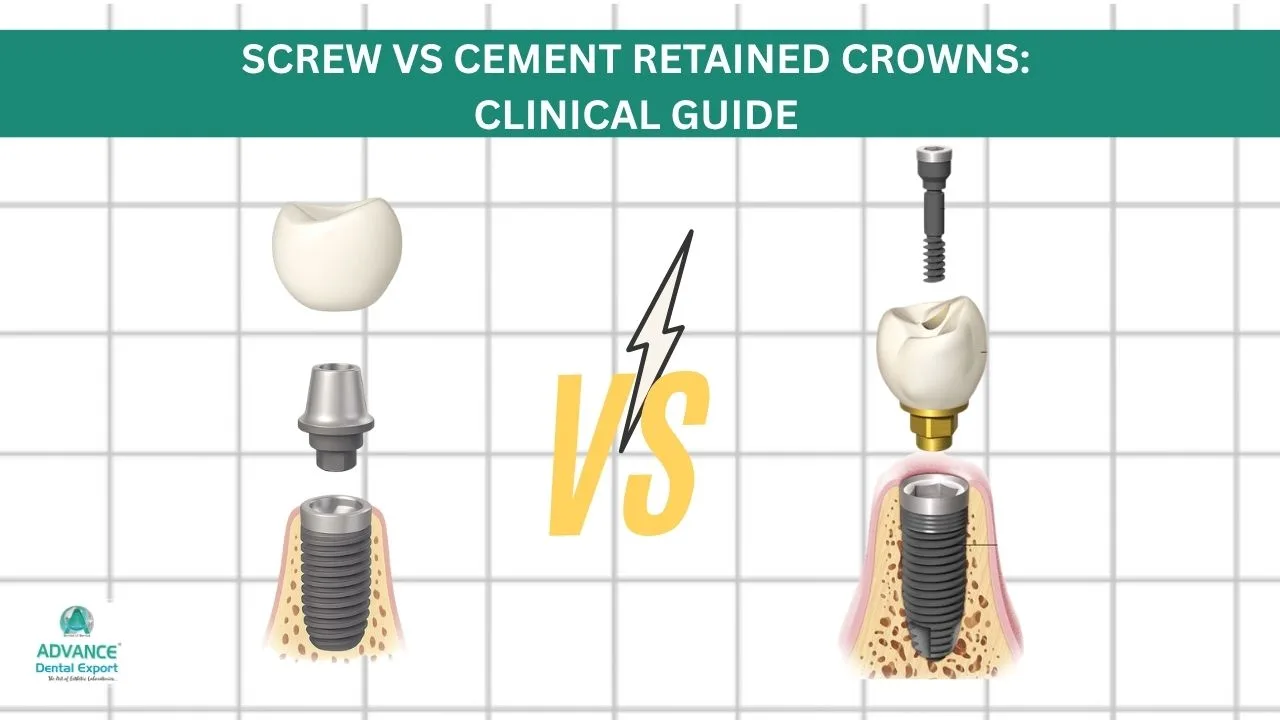
- Screw vs Cement Retention: Screw-retained crowns prioritise retrievability, whereas cement-retained crowns provide greater flexibility for managing implant angulation and aesthetic outcomes.
- Screw-Retained Crowns: Preferred when retrievability, simplified maintenance, and elimination of cement-related biological risks are clinical priorities.
- Cement-Retained Crowns: Ideal for cases where implant angulation or aesthetic requirements make a screw access channel undesirable.
- Clinical Decision Factors: Base retention selection on implant angulation, implant position, restorative space, aesthetic requirements, retrievability, and long-term maintenance needs.
- Treatment Planning: Select the retention method during treatment planning rather than after implant placement. This approach helps minimise biological and technical complications while improving long-term restorative success.
Synopsis
Choosing between cement-retained and screw-retained crowns directly influences peri-implant tissue health, restoration retrievability, maintenance requirements, aesthetic outcomes, and long-term clinical success.
Both screw-retained and cement-retained crowns provide predictable long-term outcomes when selected appropriately. Rather than determining which retention method is superior, evaluate the clinical, prosthetic, and maintenance-related factors to select the most appropriate option for each case.
This guide reviews the differences between screw-retained and cement-retained restorations. It also explains their indications, advantages, limitations, and the key factors to evaluate before finalising the restorative design.
Why Does Crown Retention Selection Matter in Implant Dentistry?
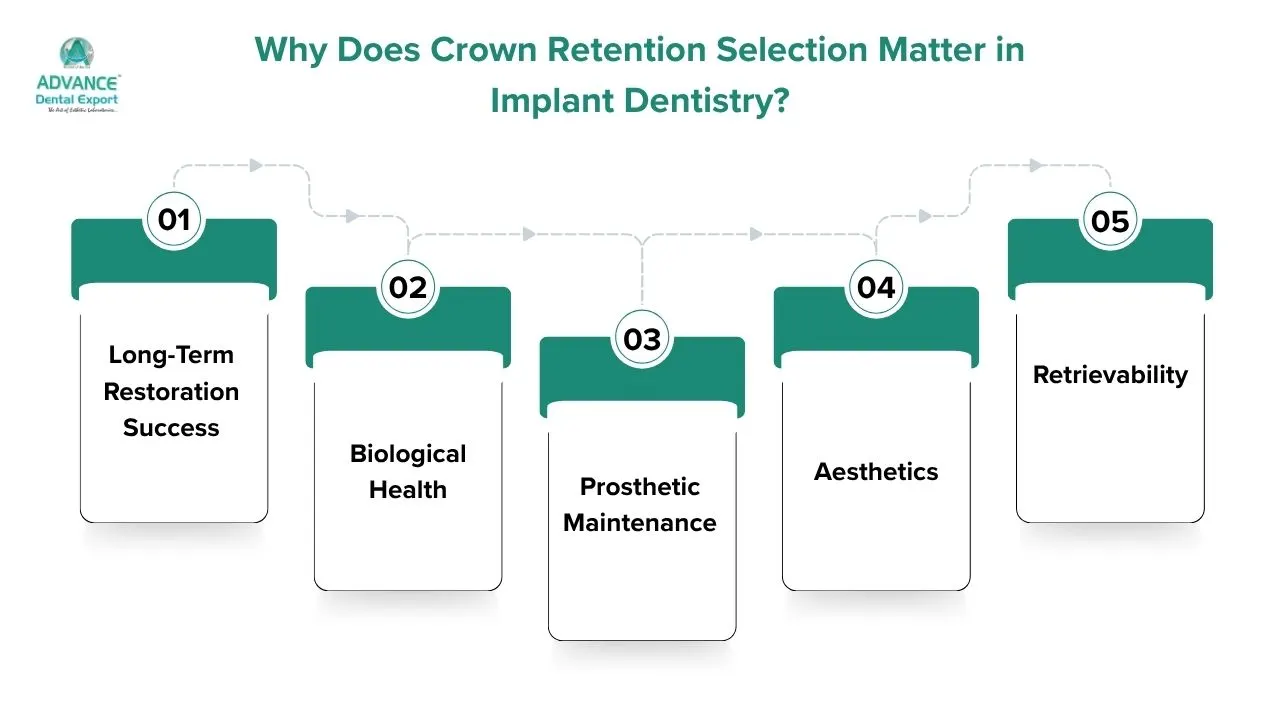
Selecting the appropriate retention is more than a restorative preference. It is a critical treatment planning decision that influences restorative outcomes. It influences the long-term success of implant-supported restorations. It also affects biological outcomes, prosthetic maintenance, restoration longevity, and laboratory workflows.
Base the retention strategy on implant position and implant angulation. Also consider restorative space, aesthetic objectives, prosthetic design, and anticipated maintenance requirements.
Long-Term Restoration Success
An appropriately selected retention method supports the long-term performance of implant-supported restorations. During treatment planning, evaluate implant position, prosthetic design, and future maintenance requirements. This approach reduces biological and technical complications. It also improves long-term restoration longevity.
Biological Health
Retention selection directly influences peri-implant tissue health and long-term biological outcomes. Cement-retained restorations require meticulous removal of excess cement. This helps prevent residual subgingival cement, which is associated with peri-implant inflammation. Screw-retained restorations eliminate this concern because they do not require luting cement.
Prosthetic Maintenance
Implant restorations may require screw tightening, repairs, component replacement, or occlusal adjustments throughout their service life. The selected retention method determines how efficiently these procedures can be performed. Evaluating future maintenance requirements during treatment planning supports predictable long-term prosthetic management.
Aesthetics
Retention selection also influences the final aesthetic outcome of the restoration. Implant angulation and the location of the screw access channel determine whether a screw-retained restoration is appropriate. If the screw access channel compromises aesthetics, a cement-retained restoration may better preserve the crown's facial and occlusal anatomy.
Retrievability
Retrievability is one of the key differences between the two retention methods. Screw-retained crowns can be retrieved without damaging the restoration. This allows predictable maintenance, repair, and component replacement. Cement-retained crowns are generally less accessible once cemented. As a result, future prosthetic interventions may become more challenging.
What is a Screw-Retained Crown?
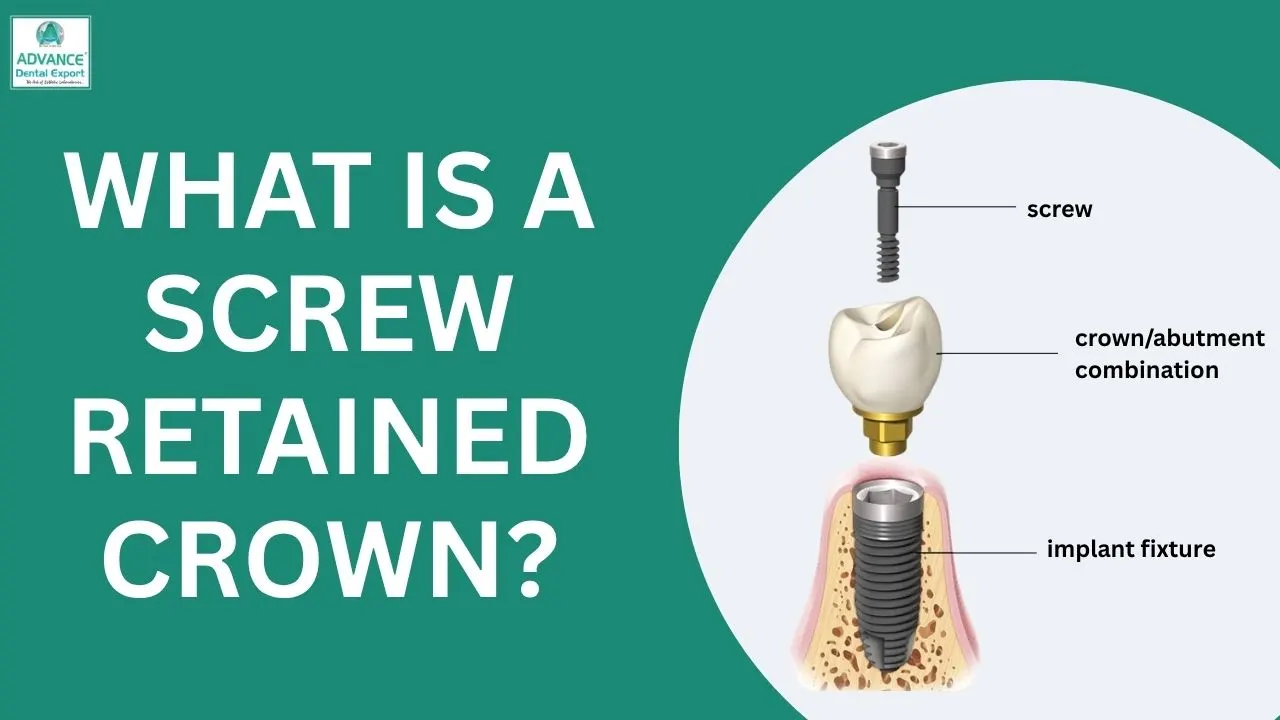
A screw-retained crown is an implant-supported restoration that is mechanically secured to the implant or Ti-base abutment using a prosthetic screw. It eliminates the need for dental cement.
After seating the restoration, tighten the prosthetic screw to the manufacturer's recommended torque. Seal the screw access channel with an appropriate restorative material. This preserves access whenever maintenance, repair, or retrieval is required.
This retention approach allows predictable retrieval and reinstallation of the restoration. It simplifies maintenance, component replacement, and other prosthetic interventions throughout the restoration's service life.


Key Features of a Screw-Retained Crown
- Mechanically retained using a prosthetic screw, eliminating the need for luting cement.
- Retrievable, allowing predictable removal for maintenance, repairs, or component replacement.
- Eliminates the risk of residual cement, reducing the likelihood of cement-associated peri-implant inflammation.
- Compatible with digital implant workflows, including CAD/CAM-designed restorations and Ti-base-supported prostheses.
- Commonly used for posterior implant restorations, full-arch prostheses, and cases where long-term maintenance is anticipated.
How Screw-Retained Crowns Work
- The implant-supported crown is seated directly onto the implant or a Ti-base abutment.
- A prosthetic screw secures the restoration using the manufacturer's recommended torque.
- The screw access channel is sealed with composite or another restorative material. The channel remains accessible for future retrieval when required.
When Are Screw-Retained Crowns Preferred?
Screw-retained crowns are generally preferred in the following clinical situations:
- The screw access channel emerges through the occlusal surface or the lingual aspect of the restoration.
- Future retrievability is a key treatment planning consideration.
- Long-term prosthetic maintenance, component replacement, or restoration retrieval is anticipated.
- The restoration is part of a full-arch implant prosthesis or a fully digital restorative workflow.
Ideal Clinical Indications
- Posterior implant restorations.
- Full-arch implant-supported prostheses.
- Cases expected to require periodic prosthetic maintenance.
- Cases where future prosthetic retrieval is anticipated.
Bottom Line: A screw-retained crown is not universally superior. It is often selected because it allows predictable retrieval and maintenance throughout the service life of the implant restoration. This advantage supports long-term prosthetic management.
What is a Cement-Retained Crown?
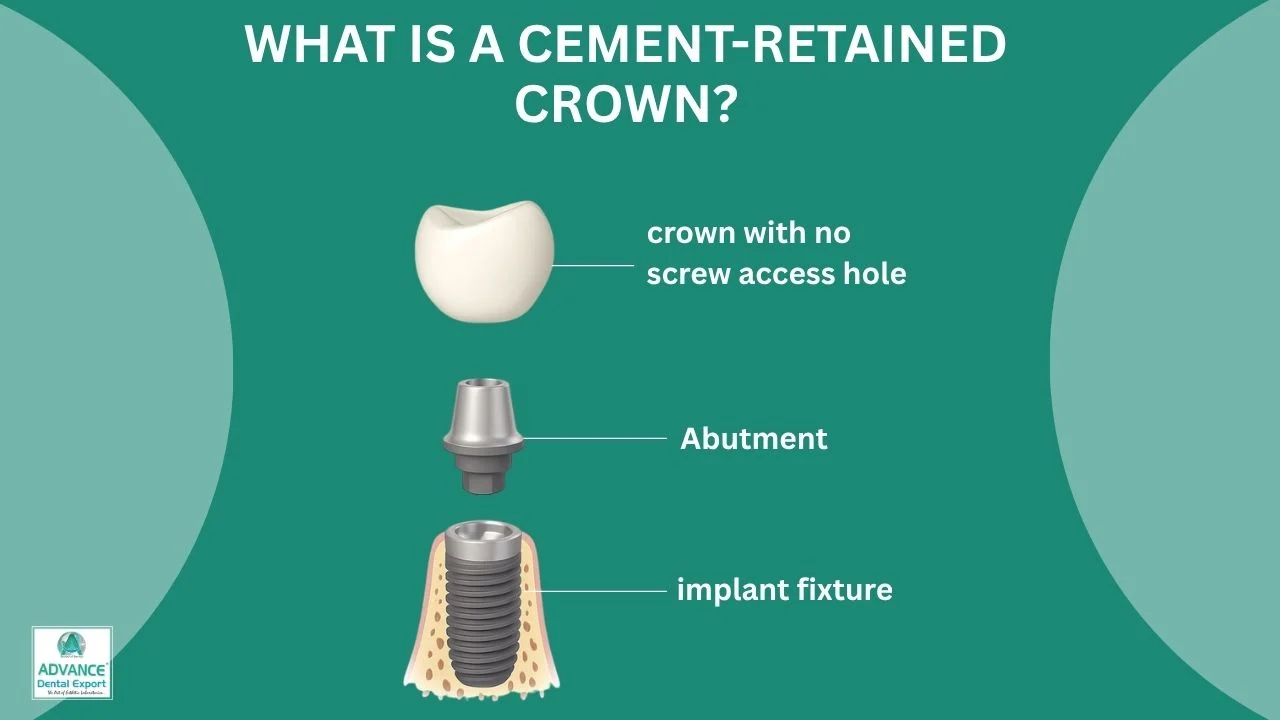
A cement-retained crown is an implant-supported restoration. The definitive crown is cemented onto an implant abutment using an appropriate luting cement. The implant abutment is first secured to the implant. The definitive crown is then cemented onto the abutment. This creates a restoration without a visible screw access channel.
This retention method is commonly selected when implant angulation or aesthetic requirements make a screw access channel undesirable. Eliminating the screw access channel preserves uninterrupted crown morphology. It also provides greater flexibility for restorative contour development.
Cement-retained crowns remain a reliable option when restorative space, implant angulation, or aesthetic requirements limit the use of screw-retained restorations.
Key Features of a Cement-Retained Crown
- Retained using luting cement rather than a prosthetic screw.
- No visible screw access channel, preserving uninterrupted occlusal and facial anatomy.
- Offers greater flexibility for crown contouring and emergence profile development.
- Accommodates less favourable implant angulation, particularly when the screw access channel would emerge through the facial surface.
- Widely used for aesthetic implant restorations where restorative appearance is a primary consideration.
How Cement-Retained Crowns Work
- The implant abutment is secured to the implant using the manufacturer's recommended torque.
- The definitive crown is fabricated to fit precisely over the implant abutment.
- The definitive crown is cemented onto the implant abutment using an appropriate luting cement.
- Any excess cement is carefully removed to minimise the risk of biological complications associated with residual cement.
When Are Cement-Retained Crowns Preferred?
Cement-retained crowns are generally preferred in the following clinical situations:
- Implant angulation causes the screw access channel to emerge through the facial surface.
- Optimal anterior aesthetics are a primary restorative objective.
- A natural emergence profile is a key restorative requirement.
Clinical conditions favour a cement-retained design to optimise crown contours and the emergence profile.
Ideal Clinical Indications
- Highly aesthetic anterior implant restorations.
- Implants with compromised angulation.
- Cases where the screw access channel would emerge on the facial surface.
- Restorations requiring uninterrupted facial crown anatomy.
Bottom Line: A cement-retained crown is often selected when aesthetics and restorative flexibility take priority over routine retrievability. Careful cementation protocols and thorough removal of excess cement are essential for maintaining long-term peri-implant tissue health.
Screw vs Cement Retained Crowns: Clinical Comparison
Both retention methods provide predictable long-term clinical success when selected appropriately.
Understanding the indications and limitations of each retention method helps you select the most predictable restorative approach for each implant case. The following comparison summarises the key differences between screw-retained and cement-retained crowns.
|
Clinical Factor |
Screw Retained Crown |
Cement Retained Crown |
|
Retrievability |
Excellent |
Limited |
|
Maintenance |
Easier |
More difficult |
|
Biological complications |
Lower |
Higher if residual cement remains |
|
Aesthetics |
Depends on screw access location |
Excellent |
|
Implant angulation |
Requires favourable angulation |
More forgiving |
|
Passive fit |
Easier to verify |
Depends on abutment accuracy |
|
Occlusal adjustment |
Easier |
More difficult after cementation |
|
Repair |
Simple and predictable |
Often requires crown removal |
|
Laboratory workflow |
Highly compatible with digital workflows |
Requires accurate cement space management |
Clinical Factors That Influence the Choice
Select the retention method based on prosthetic, biological, and case-specific clinical considerations. Avoid selecting a retention method based solely on personal restorative preference.
Looking for a trusted lab partner? Get high-precision restorations from Advance Dental Export
- Implant angulation: Screw-retained crowns are preferred when the screw access channel emerges through the occlusal surface. Cement-retained crowns may be indicated when implant angulation positions the screw access channel on the facial surface.
- Implant position: Posterior implant restorations often favour screw retention, whereas anterior restorations require careful assessment of aesthetics and screw access location.
- Restorative space: Limited interocclusal space generally favours screw-retained restorations. Cement-retained crowns require sufficient abutment height to achieve predictable retention.
- Maintenance requirements : Cases involving bruxism, complex implant rehabilitations, or anticipated prosthetic interventions generally benefit from the retrievability of screw-retained restorations.
- Biological risk factors: Evaluate oral hygiene, peri-implant tissue health, occlusal loading, and long-term maintenance requirements during treatment planning.
How Dental Laboratory Precision Supports Successful Retention
Selecting the appropriate retention method is only one part of achieving a predictable implant restoration. The success of both screw-retained and cement-retained crowns also depends on accurate laboratory planning, digital design, and precise manufacturing.
Even when the correct retention method is selected, fabrication inaccuracies can compromise restoration fit, occlusion, aesthetics, and long-term clinical performance.
Precision Matters for Screw-Retained Crowns
Screw-retained restorations rely on precise manufacturing to achieve a passive fit and accurate screw access positioning. Laboratory inaccuracies can lead to mechanical complications. They can also increase chairside adjustments and compromise prosthetic stability.
- Accurate positioning of the screw access channel.
- Passive fit between the restoration and implant components.
- Precise Ti-base bonding and accurate component assembly.
- Verification of occlusion before restoration delivery.
Precision Matters for Cement-Retained Crowns
For cement-retained restorations, laboratory design directly influences crown retention, emergence profile, and cement management. Proper abutment and crown design support predictable cementation. They also reduce the risk of biological complications associated with residual cement.
- Accurate abutment design for optimal crown retention.
- Appropriate cement space to facilitate complete crown seating.
- A well-designed emergence profile to support healthy peri-implant soft tissues.
- Margins positioned to allow effective removal of excess cement.
Digital Workflow Improves Predictability
Modern digital workflows improve the accuracy and consistency of both retention methods. Digital implant planning, CAD/CAM design, and quality control processes improve restoration fit. They also reduce chairside adjustments while improving prosthetic predictability.
- CAD/CAM-designed implant restorations.
- Systematic fit and occlusal verification.
- Consistent manufacturing quality.
- Clear communication throughout the restorative workflow.
Bottom Line: Choosing the appropriate retention method is only the first step. Long-term success also depends on precise laboratory execution. This helps ensure the planned restoration performs predictably under clinical conditions.
Take Home Message
Select cement-retained or screw-retained implant crowns based on the biological, prosthetic, and restorative requirements of each case. Avoid selecting the retention method based solely on clinician preference. Both retention methods provide predictable long-term outcomes when selected appropriately. Each offers distinct biological, mechanical, and aesthetic advantages.
Laboratory execution is equally important for long-term restorative success. Precise digital design, passive-fit verification, accurate component selection, and consistent manufacturing all contribute to the long-term clinical performance of implant-supported restorations.
Partner with Advance Dental Export for Predictable Implant Restorations
At Advance Dental Export (ADE), we collaborate with dentists and implant clinicians to deliver precision-engineered implant restorations through advanced digital workflows. We achieve this through advanced CAD/CAM workflows, rigorous quality control, and experienced technical support throughout the restorative process.
Looking for a reliable digital dental laboratory to support your implant restorations? Partner with Advance Dental Export for precision-engineered implant restorations. We help you achieve predictable implant restorations through precision-engineered CAD/CAM workflows, meticulous quality control, and dedicated technical support for every case.