Snapshot
| Metric / Dimension | Overview |
| Primary Cause of Remakes | Inaccurate impressions, ambiguous margin lines, insufficient occlusal clearance, and laboratory fabrication variances. |
| How We Reduce Them? | A 6-stage quality workflow combining high-magnification scan verification, digital CAD calibration, precision milling, and multi-tier manual validation. |
| Benefits for Dentists | Up to 80% reduction in remake rates, saving 45+ minutes of chair time per case while increasing practice profitability and patient satisfaction. |
Synopsis
A dental crown remake occurs when a custom indirect restoration fails to seat correctly and requires re-fabrication from a new impression . Advance Dental Export reduces dental crown remakes by applying a systematic six-stage quality protocol that eliminates clinical and technical errors before final delivery.
Reducing crown remakes matters to dentists because uncompensated remake appointments consume valuable chair time, delay treatment, and increase dental lab costs. Every remake requires secondary local anaesthesia, impression-taking, and temporary crown fabrication, which frustrates patients and erodes trust.
We solve this industry challenge through standardised digital inspection, calibrated Computer-Aided Design (CAD), and multi-tier quality validation. This guide details the root causes of crown fit failures, ADE's systematic prevention protocol, and actionable clinical best practices.
What is a Dental Crown Remake?
A dental crown remake is the fabrication of a replacement crown because the original restoration cannot be clinically accepted due to fit, function, aesthetics, or manufacturing errors.
In simple terms, a dental crown remake is the process of fabricating a new dental crown because the original crown cannot be delivered successfully or does not meet the required clinical or aesthetic standards. The original crown is discarded or replaced rather than adjusted.
A crown is generally considered a remake when it:
- Does not fit the prepared tooth accurately.
- Has open or inaccurate margins.
- Has incorrect proximal contacts.
- Has occlusal interferences that cannot be corrected with minor adjustments.
- Does not match the prescribed shade or aesthetics.
- Contains manufacturing defects such as cracks, porosity, or distortion.
- Was fabricated from incorrect prescription or case information.
What Causes Dental Crown Remakes?
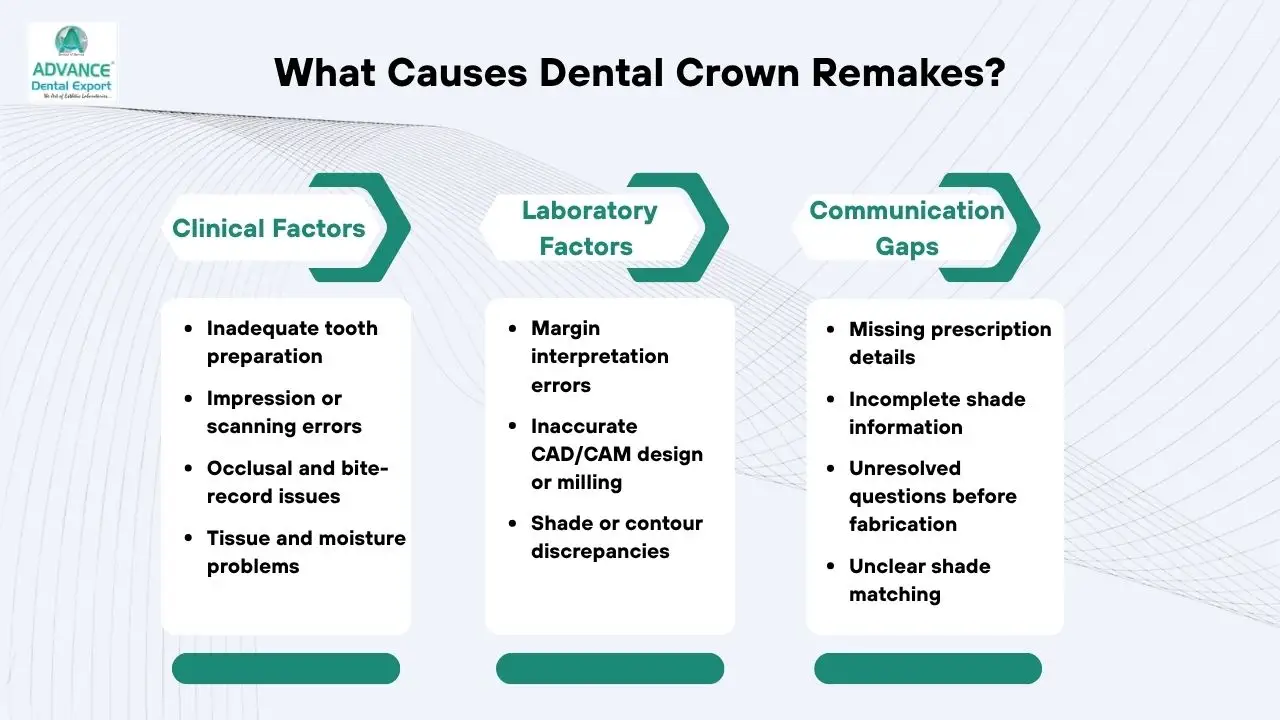
Dental crown remakes stem from accumulated dimensional variations during clinical tooth preparation , impression capture, and laboratory fabrication. Identifying these root causes allows clinicians and technicians to implement targeted preventive steps.
Common clinical issues include:
Clinical Factors
- Inadequate tooth preparation: If the prepared tooth lacks sufficient clearance or has sloped/blurry margins, we can’t fabricate a well-fitting crown. Overly thin or uneven reduction often leads to crowns that are too thin, opaque, or with margin gaps.
- Impression or scanning errors: Distorted or incomplete impressions (e.g. air bubbles, missing margin details, debris) and poor intraoral scans produce inaccurate models.
- Occlusal and bite-record issues: A faulty bite registration (or none at all) means the fabricated crown may fit the die but not the patient’s occlusion. Bite-related problems are a top cause of remakes, since even a well-made crown can hit high or not seat properly without a reliable record.
- Tissue and moisture problems : Bleeding, saliva, or inflamed gums around the margins can prevent a clear impression. If soft tissues obscure the finish line during capture, the lab may guess at the margin placement, often resulting in an ill-fitting crown.

Laboratory Factors
- Margin interpretation errors: Poorly defined margins may affect restoration adaptation.
- Inaccurate CAD/CAM design or milling: Small design or manufacturing deviations can influence crown fit and occlusion.
- Shade or contour discrepancies: Inconsistent aesthetics may require adjustment or remake before delivery.
Communication Gaps
Communication breakdowns happen when laboratory prescription forms lack clear instructions regarding shade gradient, translucency, or margin preferences. Vague instructions force our technicians to make assumptions, increasing the probability of clinical rejection.
- Missing prescription details: Incomplete lab prescriptions delay accurate case planning.
- Incomplete shade information: Missing photographs or shade references increase aesthetic uncertainty.
- Unresolved questions before fabrication: Clarifying concerns before production prevents unnecessary remakes.
- Unclear shade matching: Shade takes are notoriously tricky. Without standardised lighting or photos, it might instruct us to pick the wrong porcelain, leading to a colour mismatch.
In summary, remakes typically happen when any link in the chain – doctor, lab, or communications – fails to capture or execute the prescription accurately. Advanced workflows aim to close those gaps as much as possible.
Do You Know?: A clinical study evaluating 3,750 single-unit crowns reported a 3.8% remake rate , with marginal discrepancies, proximal contacts and aesthetic issues being the most common reasons for rejection.
How Advance Dental Export Reduces Crown Remakes
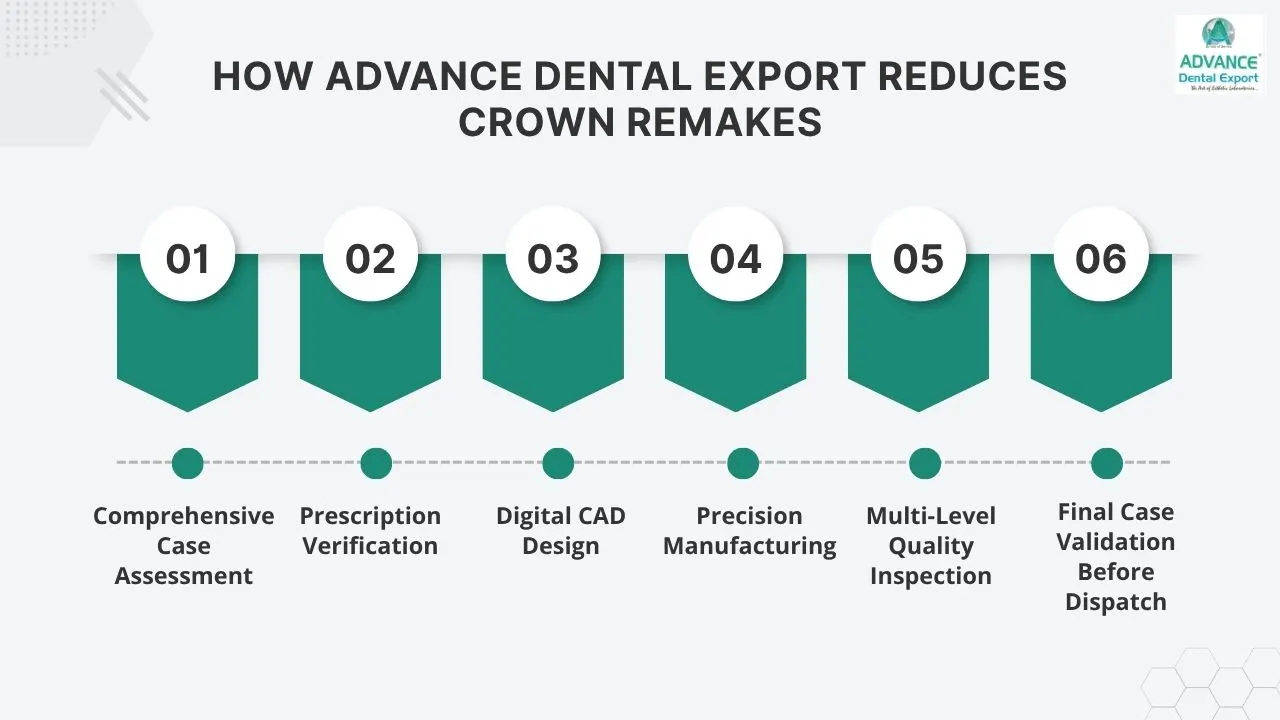
Advance Dental Export addresses each cause with a concrete process and quality checkpoint. We reduce the risk of dental crown remakes by identifying potential issues at the case review stage. Below are the key steps in our workflow, from intake to dispatch, each designed to catch and correct errors early.
Comprehensive Case Assessment
We inspect every incoming physical impression or intraoral digital scan under high-magnification optical systems before starting work. The team evaluates preparation reduction, margin clarity, and bite registration integrity to verify case viability immediately.
Prescription Verification
We review clinical directions against diagnostic scans to confirm material compatibility, shade parameters, and contact preferences. If instructions contain ambiguities, we contact the dentist or dental office before proceeding with design.
Digital CAD Design
Our CAD/CAM specialists design the crown on-screen. They use high-precision CAD software to virtually place the crown on the 3D model. Virtual articulators simulate jaw dynamics to prevent occlusal interferences before physical milling.
Precision Manufacturing
Computer-Aided Manufacturing (CAM) five-axis milling units carve restorations from certified high-density zirconia or ceramic blocks with sub-micron accuracy. Since the design matches the prescription, the mill simply follows the exact dimensions.
We also use digital devices (like optical scanners) to measure the milled crown against the design file, checking for any dimensional deviation. Sintering furnace cycles undergo daily thermal calibration to guarantee precise material expansion and strength.
Multi-Level Quality Inspection
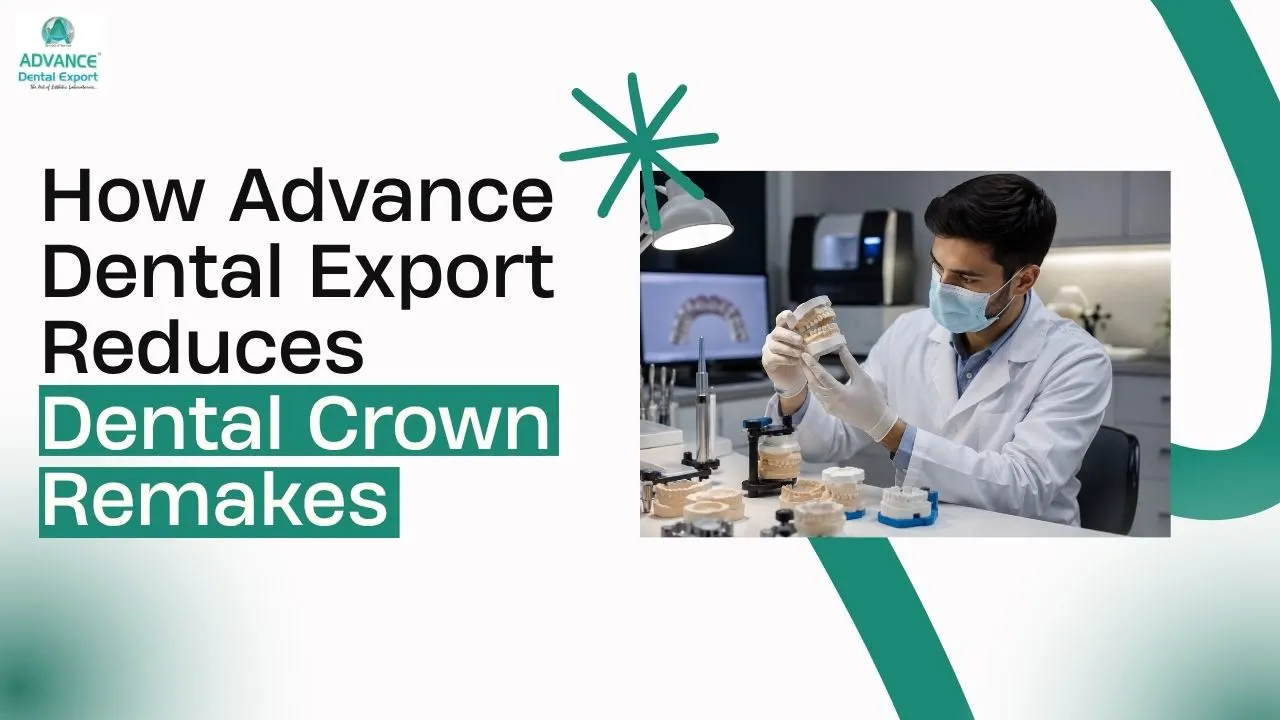
We conduct multiple quality checks before any crown leaves the lab. All our restorations undergo three distinct inspection checkpoints: post-milling, post-sintering, and post-glazing.
Experienced technicians verify internal fit on solid master dies, measure wall thickness with digital callipers, and evaluate marginal integrity under 10x magnification. This layered QC means most problems are caught in-house, far before the dentist ever sees the crown.
Final Case Validation Before Dispatch
Our senior Quality Assurance manager inspects the finished crown against original prescription requirements and digital design files. The restoration receives final dispatch approval only after satisfying a strict 12-point quality checklist covering shade match, contacts, and occlusion. In practice, this means cases almost never return – ADE’s internal audits make remakes extremely uncommon.
Looking for a trusted lab partner? Get high-precision restorations from Advance Dental Export
This disciplined approach means dentists receive nearly error-free crowns, saving many hours of chair time (often 30–40 hours per year with a 10% remake rate) and thousands of dollars in hidden costs, while patients enjoy a smoother, single-visit experience.
How Reducing Crown Remakes Benefits Dental Practices
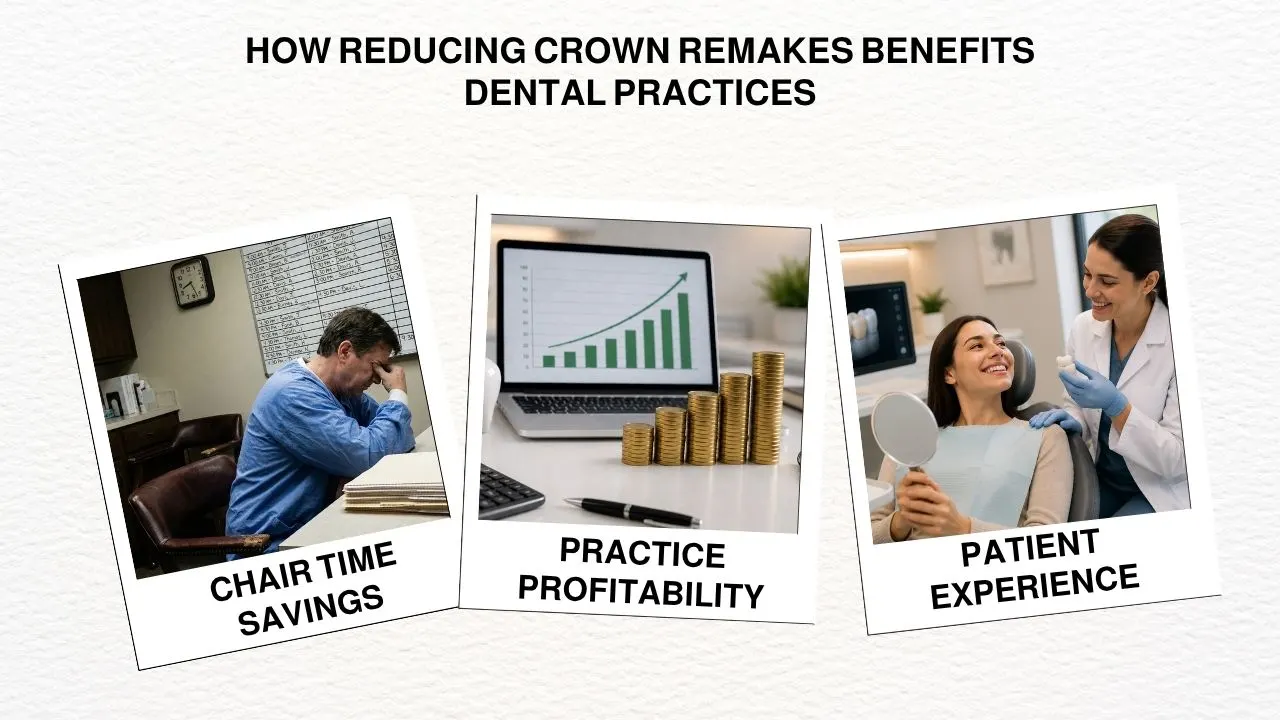
Reducing crown remakes directly improves clinical efficiency, operational profitability, and patient loyalty. Consistent laboratory quality transforms everyday crown procedures into predictable outcomes. When a practice cuts remake rates, the rewards are tangible: less wasted time, more profit, and happier patients.
Chair Time Savings
Eliminating remake appointments saves clinicians an average of 45 to 60 minutes per crown case. Dentists reallocate this recovered schedule time toward high-value elective treatments or expanded patient hygiene capacity.
Practice Profitability
For a practice with 10 remakes a year, that’s over Rs. 4 lac in lost revenue buried in overhead and fees. Fewer remakes eliminate non-billable overhead costs associated with secondary impression materials, temporary crowns, and shipping fees. Achieving first-time restoration fit maximises hourly practice revenue and lowers supply expenses.
Patient Experience
Seating crowns successfully during the initial delivery appointment builds patient trust and eliminates secondary appointment discomfort. Satisfied patients generate positive practice reviews and refer new family members and colleagues.
Best Practices for Dentists to Reduce Crown Remakes
Clinicians can significantly lower remake rates by standardising tooth preparation and impression protocols. Following a consistent clinical checklist ensures accurate data transmission to Advance Dental Export.
Providing complete information at the time of submission is essential to reduce unnecessary delays, adjustments and remakes.
- Maintain Adequate Occlusal Reduction : Provide a minimum occlusal reduction of 1.5mm to 2.0mm for monolithic ceramic and zirconia crowns.
- Execute Tissue Management : Use a dual-cord retraction technique to expose subgingival margins clearly before impression capture.
- Verify Intraoral Scans : Inspect 3D digital scans for surface voids, distortion, or incomplete contact data before finalising the capture.
- Record Bite Registration at MIP : Capture bite registration at maximum intercuspation with steady tissue contact to prevent bite elevation.
- Provide Detailed Prescriptions : Specify exact contact tightness, occlusal scheme, and shade gradients on the laboratory prescription form.
Take Home Message
Reducing dental crown remakes requires precise tooth preparation, clear clinical communication, and rigorous laboratory quality control. We at Advance Dental Export systematically eliminate restoration errors through a six-stage CAD/CAM manufacturing workflow and multi-tier quality inspection.
A structured workflow that combines accurate clinical records, proactive communication and rigorous lab quality control makes restorative outcomes far more predictable.
By combining detailed case evaluation, digital manufacturing and comprehensive quality verification, we help reduce avoidable remakes and support more predictable restorative outcomes.
To eliminate chair-time loss and elevate your restoration fit consistency, partner with Advance Dental Export for your next clinical case.